
State of the Union Highlights

By Andy Beck • March 4, 2026
Word count: 1,407words, 5.5 min. read
👋 Welcome to Big South Insights, the biweekly dispatch from Ohio River South, delivering timely intelligence and sharp analysis on the politics, policy shifts, and power players shaping the American South—because what happens here telegraphs where the country is headed.

The State of the Union — The South’s Strategic Opening
President Trump’s State of the Union was less a policy checklist than a directional signal. The themes were clear: border security, industrial capacity, domestic energy production, and technological dominance. For the South, that alignment is not rhetorical—it’s geographic. Much of the infrastructure and economic activity tied to those priorities already sits across Southern states.
National Security Is Now Economic Policy
Reshoring supply chains, expanding advanced manufacturing, and strengthening domestic production are no longer theoretical strategies. From defense manufacturing in Texas and Alabama to semiconductor expansion across the Southeast and energy exports along the Gulf Coast, the South is positioned at the center of this industrial push.
Energy Acceleration — If the System Can Deliver
The administration signaled continued support for oil and gas production, nuclear expansion, and grid reliability. The South is already leading that growth through LNG export terminals, rapid solar deployment, and major nuclear investments. But the region is also confronting the limits of its infrastructure, with transmission constraints, permitting delays, and interconnection backlogs emerging as key barriers.
Border Security and Labor Markets
Immigration and enforcement were also central to the address, with clear implications for Southern labor markets. Agriculture, construction, hospitality, and logistics industries across the region rely heavily on immigrant labor. Increased enforcement and compliance scrutiny could intensify workforce pressures even as Southern economies continue to expand.
AI, Biotech, and Strategic Competition
The speech also highlighted intensifying competition with China in artificial intelligence, biotechnology, and defense innovation. That competition aligns directly with Southern technology corridors, including Atlanta’s AI ecosystem, Austin’s semiconductor sector, and the Research Triangle’s biotech cluster.
The Takeaway
The message was ultimately about direction rather than new policy. Washington is signaling priorities around security, energy, and technological leadership. The South, already home to much of the infrastructure behind those priorities, will play a central role in turning those signals into economic execution.

Supreme Court curbs tariff authority under emergency law
A major Supreme Court ruling struck down broad swaths of the Trump administration’s tariff program, reshaping the near-term outlook for import-dependent Southern manufacturers, logistics hubs, and retailers (and raising questions about what tariff tools the White House can use next).
Supreme Court to hear climate-liability pathway case
The Supreme Court agreed to take up whether states and municipalities can sue fossil fuel companies for climate-related damages—an issue with big implications for Gulf/Southern coastal communities, insurers, municipal budgeting, and energy-sector litigation exposure.
Federal judge strikes down “third-country” deportation policy
A federal judge ruled unlawful the administration policy of removing immigrants to “third countries” where they have no ties. For Southern state/local leaders—especially in border and fast-growth metro areas—this matters for local law enforcement coordination, employer workforce planning, and the compliance environment around immigration enforcement actions.
President Trump directs all federal agencies to stop using Anthropic AI technology
The White House ordered all federal departments to cease using artificial intelligence tools from Anthropic amid a public dispute with the Pentagon over use restrictions and safety requirements. The Department of Defense has labeled the company a supply-chain risk as part of the escalation.

Congress intensifies war powers debate after U.S. strikes on Iran
Lawmakers in both the House and Senate are preparing votes on war powers resolutions aimed at restricting President Trump’s military engagement with Iran without explicit congressional authorization, setting up a constitutional clash over executive authority and defense oversight. With major military installations and defense contractors across the region, shifts in war authorization and defense policy could directly affect federal spending, procurement, and base activity in Southern states.
U.S. House fails to pass bipartisan aviation safety bill (ROTOR Act)
The U.S. House failed to pass the ROTOR Act, a bipartisan aviation safety measure that would have required advanced collision-avoidance technology on aircraft operating near busy airports, despite the Senate previously approving the bill unanimously. The setback delays potential safety upgrades and regulatory changes for several of the nation’s busiest aviation hubs located in the South, including Atlanta, Dallas–Fort Worth, Orlando, and Charlotte.
Senate Democrats introduce bill to mandate tariff revenue refunds
Senate Democrats introduced the Tariff Refund Act of 2026, legislation that would require the federal government to return roughly $175 billion in tariff revenue collected under trade policies recently invalidated by the Supreme Court. If enacted, the refunds could provide financial relief for Southern manufacturers, agricultural exporters, and import-reliant businesses that absorbed higher supply-chain costs during the tariff period.
Congress deadlocked on DHS funding as partial shutdown drags on
Congress remains locked in a dispute over funding the Department of Homeland Security, raising the prospect of a prolonged partial shutdown affecting agencies such as TSA, FEMA, and the Coast Guard. Funding uncertainty could disrupt operations at Southern ports, airports, and coastal disaster preparedness programs that rely heavily on DHS coordination and federal staffing.

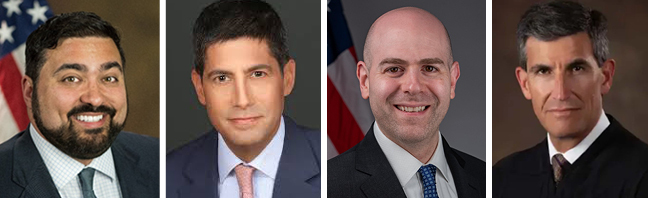
Power movers (from left): Nicholas Ganjei, Kevin Warsh, Stephen Miran, Judge Adam Tanenbaum
The U.S. Senate confirmed Nicholas Ganjei as a federal judge in the Southern District of Texas by a narrow 51–45 vote. Ganjei, previously U.S. Attorney for the district, is known for aggressively executing the Trump administration’s immigration enforcement priorities and will now preside over one of the nation’s busiest federal dockets, including border, commercial, and regulatory litigation.
President Trump officially nominated Kevin Warsh, a former Federal Reserve governor and Wall Street veteran, to be the next Federal Reserve Chair, succeeding Jerome Powell. Warsh’s economic philosophy — emphasizing potentially lower rates and stronger market responsiveness — could significantly influence monetary policy, credit availability, and borrowing costs for Southern industries like real estate, manufacturing, and energy if confirmed.
Federal Reserve Governor Stephen Miran stepped down from his role as Chair of the White House Council of Economic Advisers to resolve concerns about central bank independence. His departure coincides with the ongoing debate over the Fed’s leadership and could influence how monetary policy directions intersect with fiscal priorities important to Southern industries.
Florida Gov. Ron DeSantis appointed Judge Adam Tanenbaum to the Supreme Court of Florida, elevating an experienced appellate jurist to one of the state’s highest judicial posts. Tanenbaum’s selection — announced mid-January — will shape legal oversight and case law on business, regulatory, and constitutional matters in a state central to the Southern economy.

- Mar. 9–12, 2026 — National Association of State Procurement Officials Exchange Conference — Orlando, FL
- Mar. 25-26, 2026 — Association of Clean Water Administrators Mid-year Meeting — Alexandria, VA
- Mar. 29-Apr. 1, 2026 — Environmental Council of the States Spring Meeting — Savannah, GA
-
Apr. 8-10, 2026 — International City County Management Association Government Reimagined Conference: The AI Edge — Orlando, FL
-
Apr. 13-15, 2026 — National Association of Attorneys General Annual Conference — Charleston, SC
-
Apr. 29-May 1, 2026 — Community Leaders of America Spring National Conference — Fort Worth, TX

Mar. 2 — Fed races to adapt to AI’s economic impact
Federal Reserve officials are increasingly grappling with how artificial intelligence (AI) will reshape inflation, employment, and productivity. Some policymakers see AI driving disinflation through productivity gains, while others warn it could suppress jobs or fuel inflation due to economic restructuring. This internal debate at the Fed signals that monetary policy decisions — especially about future rate cuts or hikes — will need to account for AI’s uneven effects across industries.
Mar. 2 — U.S. manufacturing grows but input costs surge
U.S. manufacturing activity expanded moderately in February — the second month above the growth threshold — but input prices surged to a 3½-year high as material costs rose amid tariff uncertainty and geopolitical tensions. Employment in factories remains weak and delivery delays persist.
Feb. 25 — U.S. wholesale prices climb faster than expected
Wholesale (producer) prices rose sharply in January, exceeding economist forecasts as services and core goods prices recorded notable gains — the largest year-over-year increase since early last year. While energy and consumer prices moved differently, this wholesale inflation trend complicates the inflation outlook and could influence future Federal Reserve decisions on interest rates.

Thanks for reading this edition of Big South Insights! Our team hails from the New South — where we serve hundreds of clients — helping us collect insights and intelligence for 30,000 readers and counting.
Want more? Our past editions are collected here. And click here to sign up for additional insights and happenings from Ohio River South.